2 HN users recommended this tutorial2 months2014–2024score 2.5
Years with an HN recommendation, 2007–2026
HN people cite it as a practical test for pan temperature and as the way to get a stainless steel pan relatively non-stick.
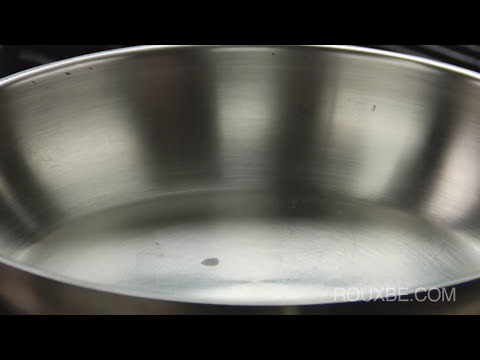
A two-minute Rouxbe cooking-school demo of how to heat a pan properly before cooking. It uses the Leidenfrost effect, where water beads and skates across a hot pan, to show when a stainless steel pan is ready.
“This youtube video explains the process” (HN, 2024)
Leidenfrost effect is how you test if your stainless steel skillet is at the right temperature for cooking. If you are into cooking, I must insist you check this out - [this video]
Leidenfrost effect as a test for proper pan temperature
Carbon steel pans are seasoned and generally will be stored with a light coat of oil. You'll add oil while cooking, as well. My carbon steel pans don't stick – an egg will happily glide on the surface. Stainless steel pans are not seasoned, but can still be relatively non-stick as long as they are heated properly prior to use. Heating them closes the pores in the pan's surface, making the surface smoother. Add oil after the pan is properly heated. This youtube video explains the process: [this video]
How to heat a stainless steel pan so it is relatively non-stick
This is called the "Leidenfrost effect." The other possible health downside to doing this in a stainless steel pan, as referenced elsewhere in these comments, is the overheating of certain cooking oils beyond their smokepoint and into temperatures that turn them potentially bad for your health. See also: [link] [this video]
Video list and Hacker News comment labels from HackerTube (prompted by @karpathy), released under ODC-By 1.0, built on the open-index/hacker-news archive. Hacker News data is provided by Y Combinator; comments remain the work of their authors. Video titles, channel names and thumbnails belong to their creators and are shown via YouTube. HackerTube Watch is an unofficial edition. Data export of 2026-10-31.
 Plays via YouTube's privacy-enhanced embed
4 Hacker News comments
From the HN archive; up to 20 kept per video, favoring different commenters. Recommendations first.
Citations, criticism and jokes