1 HN user recommended this demo1 month2018–2021score 1
Years with an HN recommendation, 2007–2026
HN cites it as a striking demonstration of how far humanoid robot agility had come.
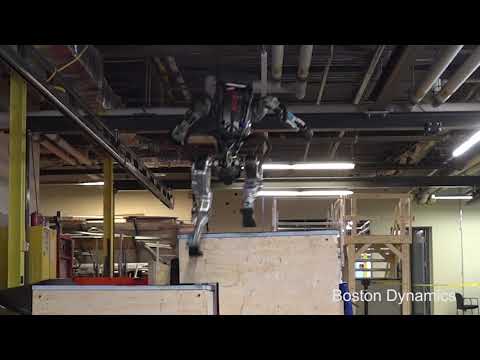
A short Boston Dynamics clip of the Atlas humanoid robot doing parkour, jumping over a log and leaping up steps using whole-body control and computer vision to locate markers.
“Their latest video of Atlas doing parkour is just insane” (HN, 2018)
I still can't understand why Google sold Boston Dynamics, it baffles me. These guys have been pushing the boundaries of robotic motion for years. I see it as another example of Google's inability to focus on anything that is not core services. Their latest video of Atlas doing parkour is just insane [0]. You'd think that with Google's focus on AI they'd want to own and keep under a tight lid tech as impressive as BD's. [0] [this video]
While full control is obviously better for some things, I wonder if overall this isn't better. It would reduce the training from having to adapt your brain to control a foreign body, to just issuing simpler commands, and might be safer too. Imagine using Atlas[1] as the exoskeleton, you just think about going forward and it navigates the terrain for you. [1] [this video]
Bipedal walking and running on uneven terrain has been demonstrated years ago - Boston Dynamics has a lot of nice videos; e.g. here's a four year old video on walking [link] , here's two year old videos on running [link] and [this video] - perhaps it's debatable if it's "full human level" but it seems sufficient to me for most purposes. IMHO any improvements to that would be mostly for sensors (seeing what terrain is there even in poor conditions e.g. fog/rain/snow) and modelling environment (understanding which objects might break or slide if you step on them), not walking/running as such. The main problem for bipedal robots that makes them still impractical is the hardware expense (wheels are simpler and cheaper) and the power supply required, so for most use cases it's more efficient to use something other than a bipedal robot and there's limited business application and future revenue in scaling up research demos of bipedal walking to practicality, so most people who are working on walking algorithms are doing so in simulated virtual environments (where we have algorithms that can learn walking and running "from scratch" through experimentation) and not building very expensive hardware.
Video list and Hacker News comment labels from HackerTube (prompted by @karpathy), released under ODC-By 1.0, built on the open-index/hacker-news archive. Hacker News data is provided by Y Combinator; comments remain the work of their authors. Video titles, channel names and thumbnails belong to their creators and are shown via YouTube. HackerTube Watch is an unofficial edition. Data export of 2026-10-31.
 Plays via YouTube's privacy-enhanced embed
4 Hacker News comments
From the HN archive; up to 20 kept per video, favoring different commenters. Recommendations first.
Citations, criticism and jokes
Read more