2 HN users recommended this talk2 months2019–2024score 2
Years with an HN recommendation, 2007–2026
HN points to it in monorepo and refactoring discussions as a great account of large-scale changes at Google.
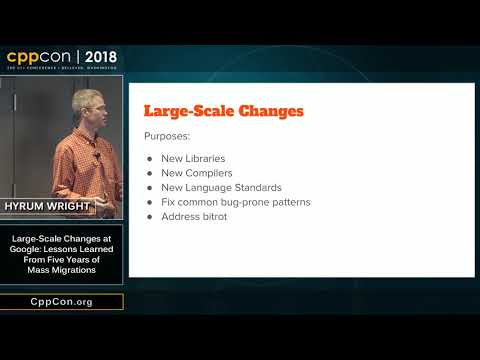
Hyrum Wright shares lessons from five years of mass code migrations in Google's huge C++ codebase. He covers why to migrate, how hard it really is, and how Google updates core libraries and their users continually.
“The discussions from Hyrum Wright from Google about large-scale refactoring are great in this respect.” (HN, 2024)
See Hyrum Wright's talks on Large-Scale Changes at Google: [link] (CppCon2014), [this video] (CppCon 2018), and paper by Googlers on ClangMR ( [link] ). It's great! And if you'd like to learn more about how monorepos work in practice there's a couple of papers: [link] and [link] (Also worth reading: [link] )
Large-scale changes at Google, with talks and papers.
Coupling happens due to other reasons than poor contracts. The discussions from Hyrum Wright from Google about large-scale refactoring are great in this respect. [this video]
Great discussion of large-scale refactoring at Google.
> Refactors are rarely as simple as moving a few file names or symbols around, at least where I work. While we do have some automation to help (and not break existing consumers), it’s significantly more involved in an SOA architecture for tier1 services. These sorts of big refactors also generally come with data model changes, performance profiling etc. This tool seems fantastic for parts of that, but not all of it. Yes, I'd refer to that as a migration, which absolutely is a lot of effort, but a tool like this isn't going to be particularly helpful with a migration precisely because the majority of the effort with such a migration will be like...doing all the data stuff and traffic stuff. Changing the code is a minimal part. A refactor is often not a thing that even registers at a smaller company, because its on the scale of a few files. But "Large Scale Changes" are a thing when you end up having millions of lines of code ( [this video] ), and tools like this one are useful for those kinds of changes. But a single LSC won't get you promoted. And rf is neat, but in a very go way, it's not particularly exciting if you're familiar with [link] or [link] or clangmr or [link] , or outside of google Semgrep and Bowler and others, since its essentially the same, but built in go for go. > Just as a friendly aside, your tone seems strangely defensive (though this may just be my fault reading this tired at 3AM) Not at all. I was however, pointing out that "this was really just a way to bra
Cited for large-scale changes across millions of lines of code.
Video list and Hacker News comment labels from HackerTube (prompted by @karpathy), released under ODC-By 1.0, built on the open-index/hacker-news archive. Hacker News data is provided by Y Combinator; comments remain the work of their authors. Video titles, channel names and thumbnails belong to their creators and are shown via YouTube. HackerTube Watch is an unofficial edition. Data export of 2026-10-31.
 Plays via YouTube's privacy-enhanced embed
3 Hacker News comments
From the HN archive; up to 20 kept per video, favoring different commenters. Recommendations first.
Citations, criticism and jokes
Read more