2 HN users recommended this video2 months2021–2026score 2.5
Years with an HN recommendation, 2007–2026
Cited in urbanism and self-driving threads as a vivid example of dense mixed traffic working through infrastructure and culture.
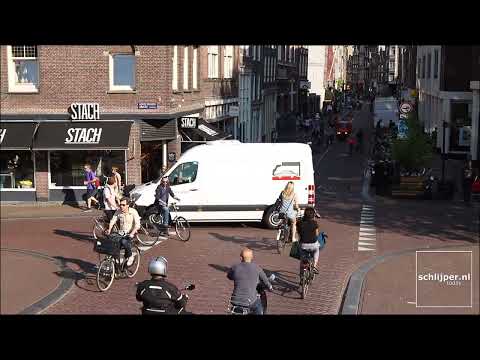
Nine minutes of unedited footage of a very busy bicycle and car crossing at Korte Prinsengracht and Haarlemmerstraat in Amsterdam. Cyclists, pedestrians and cars flow through without traffic lights.
“Watching that video sooths my mind and warms my heart” (HN, 2026)
The therapy that Juleiie needs begins by watching nine minutes of mixed car, bike, and pedestrian rush hour traffic at the intersection of Korte Prinsengracht and Haarlemmerstraat in Amsterdam. Unbelievably busy bicycle crossing in Amsterdam: [this video] Watching that video sooths my mind and warms my heart by proving how well a society of people who have not literally driven themselves mentally ill by viciously driving around in environmentally and economically destructive metal tanks can harmoniously and heathily get along together without fearing and murdering one another, by simply looking each other in the eyes and acknowledging that they all exist in the same shared space together. The famous Dutch traffic engineer Hans Monderman believed drivers become more alert and cautious when there’s more uncertainty on the road. Want fewer car accidents? Remove traffic signals and road signs: [link] >Hans Monderman believed that societies could make roads safer by making drivers more uncertain, and therefore alert. >“When you treat people like idiots, they’ll behave like idiots.” >That was the philosophy of Hans Monderman, the Dutch traffic engineer who became famous not for what he added to road design and urban planning, but for what he removed: curbs, traffic signals, signs. He believed drivers become more alert and cautious when there’s more uncertainty on the road. >“The trouble with traffic engineers is that when there’s a problem with a road, they always try to add something,”
Nine minutes of calming mixed traffic proving harmonious shared space.
To all the outlawed cyclists I'd like to say: show your fellow countrymen how it's done in the salvation state of the Netherlands. Cyclists own the roads here, see for yourself: [this video]
Shows cyclists dominating roads in the Netherlands.
Hans Monderman was the world's most famous traffic engineer! ;) [link] >Hans Monderman (19 November 1945 – 7 January 2008) was a Dutch road traffic engineer and innovator. He was recognised for radically challenging the criteria used to evaluate engineering solutions for street design. His work compelled transportation planners and highway engineers to look afresh at the way people and technology relate to each other. [link] >de Kaden shared space.wmv: Shared space traffic intersection in Drachten, The Netherlands. Traffic signals removed in 2002. The junction handles around 17,000 vehicles per day. One of many projects led by the late Hans Monderman. [link] >Shared space intersection, Drachten - The Netherlands 3,824 views Apr 29, 2009 Drachten, Drift/De Kaden, shared-space-intersection. From the centre of expertise on bicycle policy: [link] . The intersection Drift and De Kaden is an example of shared space in the purest sense. Despite a quite high traffic volume hardly any measures have been taken to regulate traffic. [this video] >Unbelievably busy bicycle crossing in Amsterdam: The Netherlands, Amsterdam, May 8, 2018 Bicycle and car traffic at the crossing Korte Prinsengracht and Haarlemmerstraat. [link] >Hans Monderman: Rethinking the design of streets and public space. >An Urban Design London and Urban Design Group Lecture Hans Monderman has been one of the most significant influences on the current debate about the design of streets and spaces in the UK. A traffic engineer
Busy Amsterdam crossing cited in Monderman shared space list.
Try to count the number of helmets you can spot: [this video] [link] In Amsterdam if we see adult cyclists with a helmet we'd guess it's probably a tourist or new expat. For children most parents only bother with helmets until they're six years or so.
> subtractive solutions and don’t “grow the GDP” like brand new EVs Maybe GDP is a bad metric. In any other field, a metric this naïve would be laughed out the door. If GDP is trying to capture net effective productivity, then let's stop using a metric that's 2 degrees of aggregated abstraction away from this metric of interest. Cars are middlemen. They allow labor to reach a location that performs a productive activity. They produce no productivity of their own. IE. Cars are network IO. Whichever transport method maximizes throughput and minimizes latency for the least cost is ideal. Any decent engineer knows that the key to better network IO is to: * improve locality - (keep things near each other) * batch things together - (buses and trains) * reduce size of individual packets - (cycles instead of huge cars) * no lossy transmission - (maintain worker productivity, stave off obesity) * avoid waits as much as possible, let actions happen async ( [this video] )
> A bicycle is trash (fun to ride, not that useful). Entirely dependent on the infrastructure: [this video] > What are you going to carry on your bike? Five bags? Seems like a lot of groceries to buy at a time, but if you really want to: [link] > I don’t want to go 5 miles away, I want to go 200. You cover 200 miles every day? [link] Regardless, you can own a car for those longer journeys just fine and still make most trips by bicycle. > With bikes and walking, your world is small. Yeah, that's why public transport is important too. Cars as well, although deprioritized. > Electric cars powered by renewable energy get rid of most of the negative externalities. They get rid of some of the noise and almost all of the harmful exhaust. That's about it. They're still 2 ton+ massive steel cages that are incredibly dangerous to everyone else, take up a ridiculous amount of space, and require extremely expensive infrastructure. As for the rest, sure, I'm not really criticising your particular choices, it sounds like you live in a rural area where a car is necessary anyway. However, there's no way for everybody to be able to live like you do. There are just too many people. We need to live with long-term sustainability in mind.
Shows bicycles work when infrastructure supports them.
You're comparing living in a car dependant city vs living in car dependant suburbs. It's not going to be meaningfully different. You mention the constant noise, but what do you think causes it? To see what everyone means by car dependency, you'd need to see the few places that aren't. Here's what a 100% car-free island looks like: [link] Here are some progressive European cities that have started to undo the damage that's been done by cars: • Freiburg, Germany: [link] • Haarlem, Netherlands: [link] • Paris, France: [link] Check out these background noise levels: • A very busy mixed-use street in Amsterdam: [this video] • Exiting the train station in Delft, Netherlands: [link] • Cycling streets in the Netherlands: [link] . You can even hear birds chirping at 4:29.
Shows background noise levels on a very busy Amsterdam street.
A meme you say? [this video] As for the excuses: > they are a small What does a size of a country have to do with how their cities are designed? > dense Same as above, unless you mean city density in which case there's nothing special about Dutch cities. > flat Yes, and? > an oceanic weather Yeah, it rains all the time and yet they cycle.
Meme-famous footage of Dutch cycling in busy city.
> There will be no red lights, no parking lots, less congestion, fewer accidents. In 20 years? Here's a 7 year old video: [this video] Also, you forgot to mention the silence, nearly zero cost infrastructure, nearly zero environmental impact, and immense population-wide health benefits—and therefore healthcare cost savings.
Existing bike-friendly traffic that already works without red lights.
On my first visit to Amsterdam, my friend picked me up on a bike at Centraal Station, and I rode to his apartment in the traditional Dutch style sitting on the back rack. On the way said "only three more mountains to go till we're home"! I asked "WTF?" and he explained that's what they call the bridges over the canals. This is one of the intersections we went through right after one of the mountains, showing how much the local culture affects the traffic safety and bicycle friendliness as much as the geography: [this video]
Intersection showing how local culture shapes traffic safety.
Video list and Hacker News comment labels from HackerTube (prompted by @karpathy), released under ODC-By 1.0, built on the open-index/hacker-news archive. Hacker News data is provided by Y Combinator; comments remain the work of their authors. Video titles, channel names and thumbnails belong to their creators and are shown via YouTube. HackerTube Watch is an unofficial edition. Data export of 2026-10-31.
 Plays via YouTube's privacy-enhanced embed
10 Hacker News comments
From the HN archive; up to 20 kept per video, favoring different commenters. Recommendations first.
Read more
Citations, criticism and jokes
Read more
Read more
Read more
Read more